This year’s event is once again centered around the theme “Quality, Safety, and Security for Automotive Software-Based Systems.”
Process Fellows were represented with two presentations.
On the second day of the conference, our Fellow Bernhard Sechser, a member of the INTACS® Advisory Board, will kick things off with his presentation 20 years of INTACS® – A Success Story:
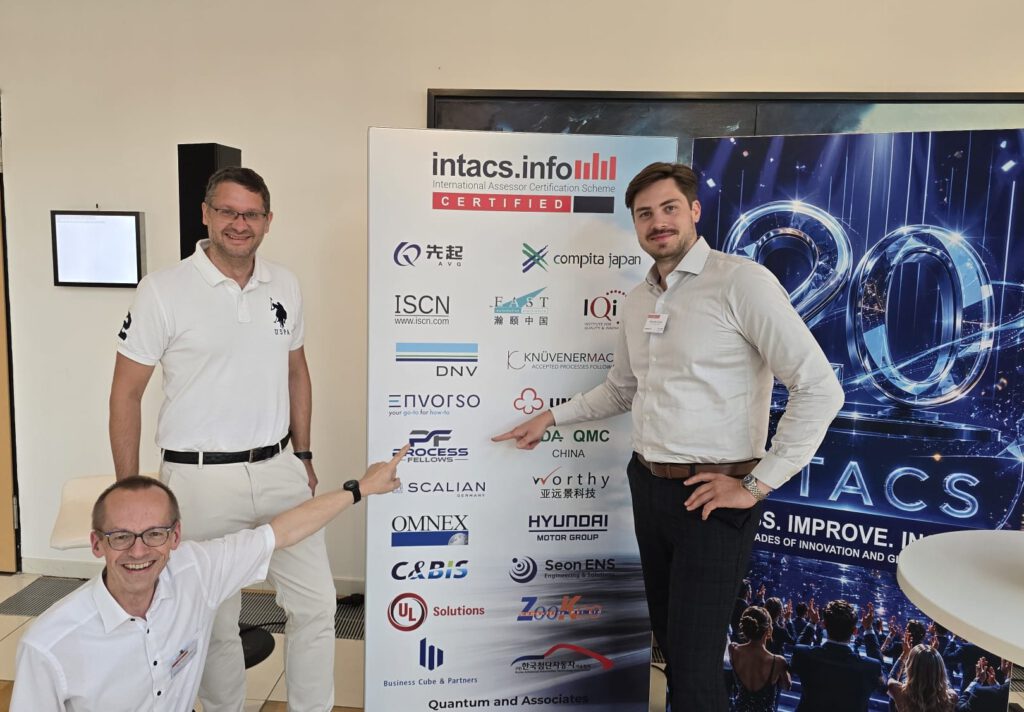
INTACS® – the “International Assessor Certification Scheme” – has been in existence for 20 years now. The scheme defines a global and uniform training program to which all prospective assessors must undergo. This represents an almost unique success model in the automotive industry in terms of system and software quality, if you compare it with topics such as functional safety or cybersecurity, where there are many different training opportunities. In this talk, we presented the highlights and peculiarities of the scheme, but we also shed light on the changing environment that INTACS® has to face. What changes and innovations does the scheme have to take into account in order to be able to continue this success? Ultimately, everything depends on the people involved and the processes involved in order to be able to successfully compete for the next 20 years.
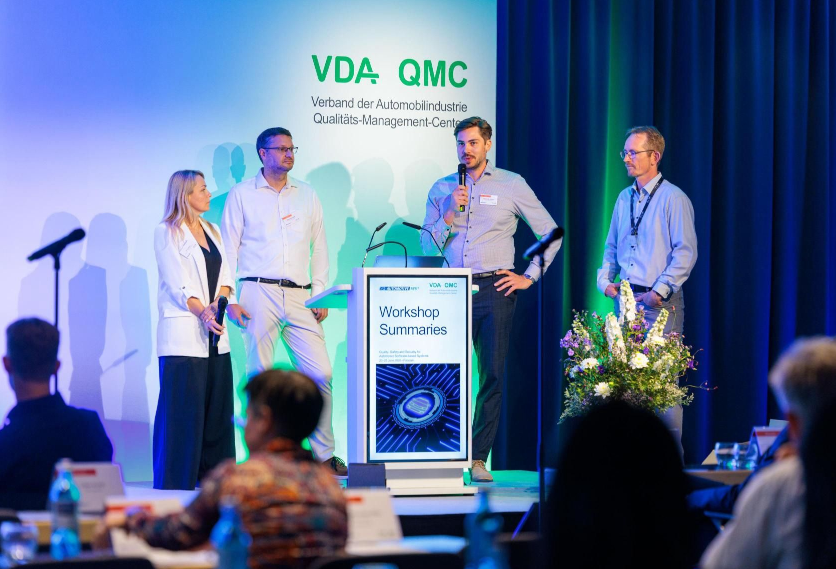
Also, on the second day of the conference, our Fellows Alexander Feulner and Sebastian Keller welcomed the participants to their workshop session Make it or Fake it – Human vs. AI: Efficiency in Creation, Review Effectiveness, and Fake Evidence Detection, for which they were honored with the “Best Workshop” Award.
Generative AI can produce requirements, documentation and other evidences in minutes – often faster than engineering teams can validate or even review the results. This raises a key question for projects and assessments alike: are we improving engineering efficiency, or are we creating a convincing illusion?
In this interactive workshop, they explored three practical angles:
Efficiency in creating work products: What changes when requirements and evidence are created with AI support compared to traditional approaches?
Efficiency and Effectiveness in reviewing work products: How does human review compare to AI-assisted review in terms of speed and effectiveness?
Detecting assessment-only artifacts: How can we distinguish project-used evidence from work products that were mainly created to “look good” for an assessment – especially when AI is involved?
The workshop was not about teaching how to cheat, but about building shared
understanding, terminology and pragmatic criteria to use AI responsibly while protecting evidence integrity. Participants left with a clearer view of benefits, limitations and guardrails for AI-assisted evidence in engineering and assessment contexts.
Did you miss the workshop? Then why not check out the recording of our free webinar, “Make it or Fake it – A Wrap-Up of the VDA SYS Workshop on AI, Reviews, and Engineering Evidence” which covers exactly this topic.